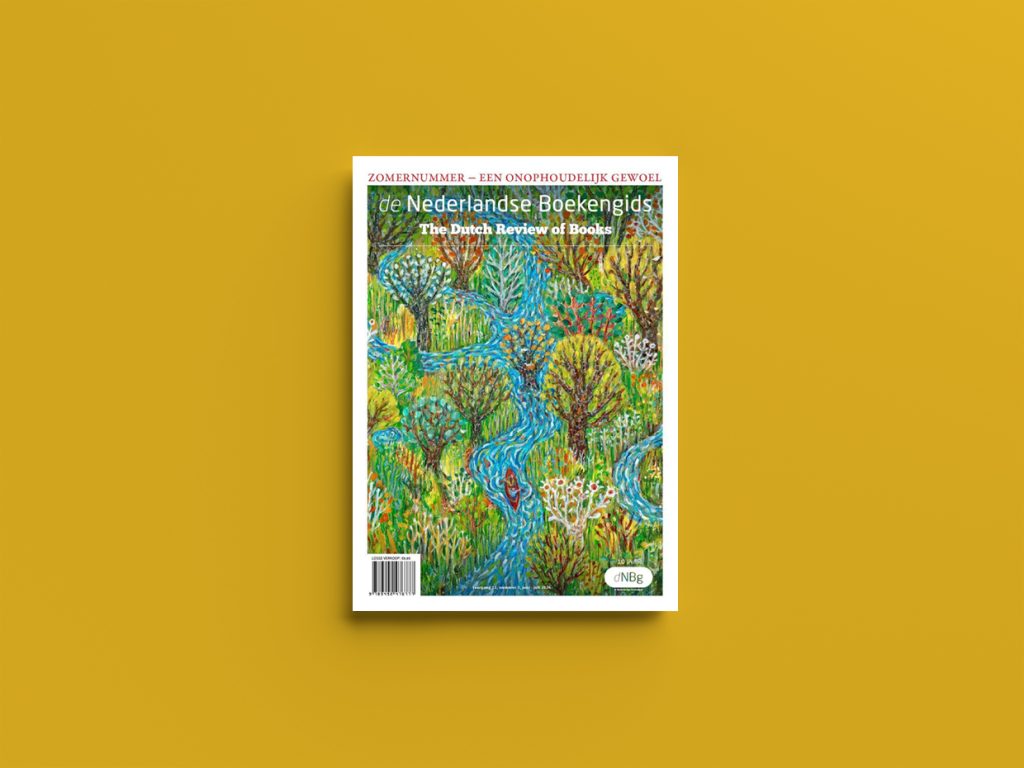
In the summer issue of Dutch Review of Books, Guido Snel gives a scathing review of Olivera Simić's Madam War Criminal, a series of interviews with Biljana Plavšić, the former Bosnian Serb vice president convicted of crimes against humanity.
Now elderly and having served her sentence, Plavšić still denies responsibility, a symptom, Snel argues, of a ‘systemic culture of genocide denial'. Plavšić helped lead Republika Srpska during the Bosnian War, during which Bosniaks were subjected to ethnic cleansing under the banner of a pseudo-scientific ideology of Serbian superiority.
These racist tropes remain central to Plavšić's worldview, yet Simić, despite her expertise in transitional justice, too often fails to challenge or adequately contextualize them. Instead, she relies on ‘an implicit pact' with readers already familiar with the historical record, leaving them to navigate Plavšić's ‘universe of concealment, distortion and alternative facts' with too little intervention.
Plavšić was introduced to Simić through the author's aunt, a close friend of the former politician – a backstory that, Snel argues, demanded far greater transparency and self-reflection. Drawing on Janet Malcolm's psychoanalytic framework, Snel argues that the usual parent-child dynamic is fundamentally reversed. Plavšić assumes ‘the role assigned to her by the script of Serbian nationalism: she is the primordial mother,' while Simić becomes ‘the lost daughter of the diaspora,' unable to get a grip on her own narrative.
Is there anything to be learned from this ‘disappointing' book? Perhaps in showing researchers precisely what not to do. Interviewing a revisionist, Snel argues, requires researchers to first establish their own narrative. Only then can they unravel the tropes and commonplaces holding together the interviewee's ‘ramshackle historical and personal narrative'. If academic research fails to do this, it is ‘creating space for precisely those ideas it claims to oppose'.
Knowing with uncertainty
‘Life – every life – is a long chain of chance occurrences', writes Geerdt Magiels, who explores human uncertainty with the aid of Adam Kucharski's Proof and David Spiegelhalter's The Art of Uncertainty.
Magiels begins with Spiegelhalter, who has a quiz asking readers to judge statements and rate their confidence in their responses. The message is clear: what matters is not simply being right, but accurately gauging what we know and how certain we can be. This is Bayesian inference, and it underpins everything from forensic science and DNA analysis to weather forecasting and search engines; indeed, even our brains are Bayesian machines, recent evidence suggests.
If uncertainty is unavoidable, how can we know anything with confidence? In Proof, Kucharski sets out in search of firmer ground, tracing humanity's efforts to distinguish fact from fiction. He explores how evidence is manipulated, whether by online misinformation or the professional ‘merchants of doubt' who deliberately manufacture uncertainty (such as the tobacco lobby). Magiels concludes that ‘gullibility is no virtue, but neither is excessive scepticism … since both dispense with the need to think'.
Split down the middle
Has the concept of class been eclipsed by ‘identity politics'? If so, how might class analysis be brought to bear once again on contemporary society? Such questions run through Arnold de Groot's comparative review of Dylan van Rijsbergen's De net-niet elite (‘The Almost-Elite') and Dan Evans's A Nation of Shopkeepers.
Both authors argue that the category of class should regain a central place in leftwing thought. Van Rijsbergen turns his gaze on his own social group: the highly educated, whom he portrays as individualistic, obsessed with upward mobility, and convinced that their success stems solely from honest hard work.
Evans offers a similar framework, distinguishing between an ‘old' petite bourgeoisie of artisans and shopkeepers and a ‘new' white-collar lower-middle class driven by personal advancement. The latter, who have often experienced upward mobility at first hand or through their parents, remain haunted by the fear they may ‘slip back down' the class ladder. Above them, a second middle class of managers and professionals, bolstered by ‘inherited wealth, social networks, role models or expectations about life trajectories', enjoys a firmer perch.
But is holding up a mirror to the middle classes enough to bring about change? De Groot is unconvinced. He questions whether insight and persuasion alone can transform the values of the middle classes or build support for the radical programmes that both authors advocate. Perhaps, he suggests, people's outlooks will change only after society itself has been transformed. ‘That appears to be the Catch-22 in which the left finds itself.'
Who decides who deserves?
Who deserves social welfare, and who gets to decide? This question runs throughout Merlijn Olnon's interview with Femke Roosma, a political scientist researching the transformation of the Dutch welfare state. Looking back on her upbringing and career, Roosma explains the thinking behind the book she is now writing.
‘Social democracy was instilled in me from an early age,' she says. Raised in a family steeped in local politics and civic life, she was drawn to political science to understand ‘how power works'. Initially reluctant to enter politics herself, she eventually joined GroenLinks (a green and progressive social-democratic party), serving for twelve years on Amsterdam's municipal council alongside working as an academic.
Roosma is now examining how growing emphasis on who ‘deserves' support has reshaped the Dutch welfare state. The drive to make social policy ever ‘fairer', she argues, has produced a more complex system, weakened trust and alienated many from the very institutions meant to protect them.
Only by loosening our grip on a narrow conception of fairness, Roosma argues, can we recover the values on which the welfare state was built: solidarity, dignity and reciprocity. Restoring those principles, she believes, would create a simpler, more humane welfare state that again ‘belongs to all of us' – including the ‘hard-working Dutch person', should they ever need it.
Review by Cadenza Academic Translations