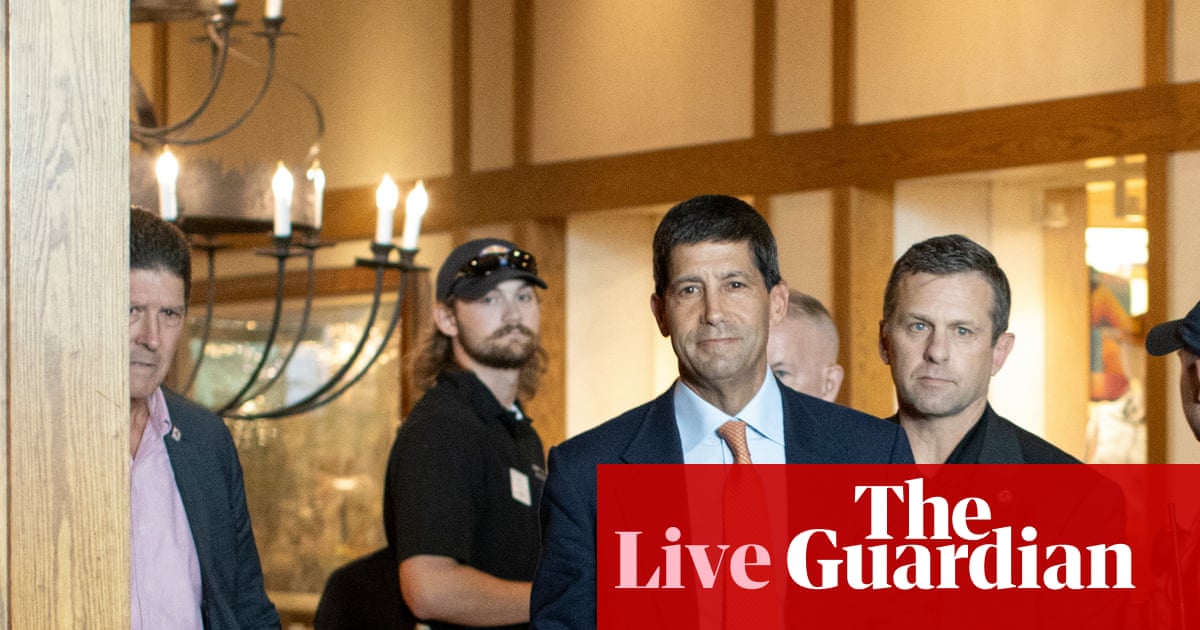
Warsh: Fed will have ‘work to do’ on high inflation unless prices ease
The US's top central banker then warns that there are concerning signs that US inflation is running too high, meaning the Federal Reserve may have “work to do†unless price pressures ease.
In his speech to the Jackson Hole symposium today, Kevin Warsh points to signs that some prices are rising rather faster than the Fed's 2% target.
Fed chair Warsh indicates that he is more concerned about inflation, than the labor market (where the unemployment rate remains low), declaring that “the Fed's predominant focus right now should be on prices.â€
He says:
double quotation mark Over the past 12 months, 54% of goods and services in the PCE basket showed price increases above 3%. This is well below the post-pandemic highs of about 77 percent, but it remains well above the level of 32 percent in the two decades that preceded the pandemic.Looking over just the past six months, the conclusion is similar: Of goods and services in the PCE basket, 49 percent showed annualized price increases above 3 percent. Again, this is well below the post-pandemic highs but still quite elevated.
Warsh reminds his audience that the Fed's monetary policy committee warned in July that inflation “remained too highâ€, and cautions that this summer's inflation data has not shown him that underlying trends have meaningfully improved.
And in a hint that he could push for tighter monetary policy to squeeze out inflation pressures, Warsh says:
double quotation mark We must be confident that underlying inflation is moving to our objective, clearly and at sufficient speed. Otherwise, we have work to do. That's our job . . . our mandate . . . and our charge to keep.
Key events
Markets see 55% chance of September rate hike
The financial markets now believe the Federal Reserve is more likely than not to raise interest rates next month, following Kevin Warsh's speech.
Data provider CME's Fedwatch tool shows that a rate hike in September is now seen as a 55.5% possibility, up from just 35.4% yesterday.
That suggests investors are heeding Warsh's warning that there may be ‘work to do' to tackle inflation (see earlier post).
Christian Hantel, portfolio manager at investment firm Vontobel, explains:
double quotation mark “Investors gained greater clarity from Fed Chair Kevin Warsh, who delivered a hawkish speech at this year's Jackson Hole symposium. They can take reassurance from the Fed's strong commitment to achieving its 2% inflation target and from Warsh's acknowledgment that significant work remains to be done before that goal is reached.At the same time, investors should expect a quieter US central bank when it comes to forward guidance. Rather than relying heavily on Fed communication, market participants may increasingly need to draw their own conclusions.
Warsh clears way for early rate hike, analysts say
Fed chair Kevin Warsh has ‘clawed back his credibility' with his hawkish remarks today, says analysts at Capital Economics.
In a rapid-fire reaction, they have told clients:
double quotation mark Fed Chair Kevin Warsh's speech at the Jackson Hole Symposium delivered a far clearer – and hawkish – message than his last press conference appearance, with Warsh arguing that the recent softer price data do not indicate that “underlying trends have meaningfully improved†and, absent more progress, the Fed has “work to doâ€.If anything, that leaves the door open to a hike earlier than our current forecast of December, if the forthcoming price data are firm.
The market reaction backs this up – two-year US bonds have weakened, pushing up the country's cost of short-term borrowing, a sign that the markets are anticipating rate hikes.
Long-term borrowing costs dipped a little – a sign that the markets are less worried that the Fed might lose control of inflation.
Reuters has the details:
double quotation mark Short-term Treasuries sold off in anticipation of rate increases as soon as next month, with the 2-year Treasury yield rising 6.6 basis points to 4.29%, its highest in a month. The 10-year Treasury yield was up 1 basis points at 4.682% and the 30-year Treasury yield was down 2 basis points at 5.17%.
Warsh: Fed will have ‘work to do’ on high inflation unless prices ease
The US's top central banker then warns that there are concerning signs that US inflation is running too high, meaning the Federal Reserve may have “work to do†unless price pressures ease.
In his speech to the Jackson Hole symposium today, Kevin Warsh points to signs that some prices are rising rather faster than the Fed's 2% target.
Fed chair Warsh indicates that he is more concerned about inflation, than the labor market (where the unemployment rate remains low), declaring that “the Fed's predominant focus right now should be on prices.â€
He says:
double quotation mark Over the past 12 months, 54% of goods and services in the PCE basket showed price increases above 3%. This is well below the post-pandemic highs of about 77 percent, but it remains well above the level of 32 percent in the two decades that preceded the pandemic.Looking over just the past six months, the conclusion is similar: Of goods and services in the PCE basket, 49 percent showed annualized price increases above 3 percent. Again, this is well below the post-pandemic highs but still quite elevated.
Warsh reminds his audience that the Fed's monetary policy committee warned in July that inflation “remained too highâ€, and cautions that this summer's inflation data has not shown him that underlying trends have meaningfully improved.
And in a hint that he could push for tighter monetary policy to squeeze out inflation pressures, Warsh says:
double quotation mark We must be confident that underlying inflation is moving to our objective, clearly and at sufficient speed. Otherwise, we have work to do. That's our job . . . our mandate . . . and our charge to keep.
Onto the state of the economy, where Kevin Warsh says he is “impressed†by its overall performance, which appears to have strengthened.
double quotation mark One indicator of strength is how well an economy holds up to shocks. On that score, both Main Street and Wall Street have been remarkably resilient.
Warsh’s six principles for running the Fed
Kevin Warsh runs through six principles that will underpin his time leading the Federal Reserve.
-
First, the Fed will “interrogate reality†to make sure it is not setting forward-looking policy based on stale or inaccurate data, or ‘yesterday's news'
-
Second, the Federal Reserve's actions are intended to ensure that the aggregate demand side of the economy is broadly consistent with aggregate supply.
-
Third: The Fed's price-stability objective of 2%, as measured by the personal consumption expenditures (PCE) price index, is “a firm, fixed targetâ€.
-
Fourth, the Fed also bears responsibility for maximum employment.
-
Fifth, short-term interest rates are the predominant tool to achieve the dual mandate, rather than using ‘unconventional policies' to spur economic activity.
-
Sixth, “money mattersâ€: the Fed should pay attention to money created by the central bank and money that comes from the banking and financial systems
-
Finally, the Fed will be in a better position to meet its objectives if it is “quieterâ€
Warsh: there are either reasons or results
Kevin Warsh puts his finger on an important point – if the Fed, or the financial markets, mess up, the most serious harm is likely to befall those without financial assets.
As he puts it:
double quotation mark If the Fed gets inflation wrong and judges the economy wrong, who gets the worst of it? Not the financial high-fliers. Hard-working Americans are the ones left to deal with inflation that is too high or jobs that suddenly appear less secure.
He pledges that the Fed will “endeavor†to construct more reliable models and more robust rules to guide policy decisions, adding:
double quotation mark We'll do this knowing that accuracy in economic forecasting is still just an aspiration
A “quieter Fed†will be better able to meet its objectives, he insists- pledging to be judged on its results (its mandate is to control inflation and deliver full employment)
double quotation mark And we can be held accountable for delivering on our remit—the only true test of our credibility. To borrow a line from General Chuck Yeager, “At the moment of truth, there are either reasons or results.
Watch Kevin Warsh’s speech here
Warsh: Forward guidance has overstayed its welcome
Kevin Warsh moves on to criticising the practice of ‘forward guidance' – something he's really not a fan of.
Forward guidance is the practice where central bankers signal future monetary policy intentions, such as the likely, or expected, path of interest rate.
Warsh argues that “the practice has overstayed its welcomeâ€, claiming it “risks creating ambiguity in the name of clarityâ€.
He also hints that investors shouldn't expect the Fed to hold their hands, saying:
double quotation mark Market participants themselves should be tracking real information across the economy. They should draw their own conclusions; form their own expectations of output, employment, and inflation; and stay sharply attuned to risks.
Warsh: AI can deliver growth, but who makes the money?
Artificial intelligence is providing the potential for “substantially higher growth†in future, Federal Reserve chair Kevin Warsh declares.
Warsh explains that the Fed is watching AI closely, telling the Jackson Hole symposium:
double quotation mark Ever-expanding pools of capital are pouring into AI-related infrastructure of all sorts. A kind of hyper–Moore's law seems to be playing out. Scaling laws, too, are changing both the method and speed of innovation.Capital and labor have combined to create the large language models at the heart of AI. Users buy tokens to gain access to the models. Reports put annualized token sales for the two leading labs alone at more than $100 billion—an increase of 500-plus percent from a year ago.
The Fed watches all of this attentively. We recognize that AI is a new variable—potentially a new factor of production—that will have consequences for both the economy and the conduct of monetary policy.
AI also opens “some major lines of inquiryâ€, he explains:
double quotation mark Will the application of AI cause a significant, sustained rise in productivity across the economy? And if so, when?Will token usage be complementary or competitive to labor? Will the next generation of AI models demand even greater capital intensity, or will the models themselves help devise a capital-light solution?
Another AI unknown, Warsh adds, is the market structure that will result – “who gets to make the money�
The Fed chair says:
double quotation mark It's not obvious where the returns on capital will land or on what timescale. Early on, how much of the surplus goes to owners of scarce assets—AI labs, chipmakers, energy producers, and cloud providers? Over time, how much of that value accrues to businesses and consumers? What are the broad implications for workers and for the employment side of the Fed's mandate?
Kevin Warsh then says that his remarks today will be an “outline†or a “trail map†of the economic situation, adding:
double quotation mark Just don't call it forward guidance.
Warsh speech begins
Over at Jackson Hole, Wyoming, the world's most powerful banker is beginning to give a closely watched speech.
Kevin Warsh, chair of the Federal Reserve, begins his address to top central bankers and policymakers with a joke about hiking in the great outdoors.
Warsh says:
double quotation mark As I learned years ago, you can take two different kinds of hikes on the trails around Jackson Hole. I can sum up my hikes with former Vice Chairman Don Kohn in two words: I survived. These steely marathon death marches revealed a side of Don I wasn't ready for.There's another kind of hike—one I associate with Chairman Ben Bernanke, my old colleague. With Ben, it's a much more leisurely pace, an easy stroll along the wandering trails at the Rockefeller Preserve.
So before setting out, do a wellness check and ask yourself: “Is this a Kohn day or a Bernanke day?â€