IMF hails UK’s budget deficit improvement
Newsflash: The International Monetary Fund has applauded the UK's progress in reducing its budget deficit last year.
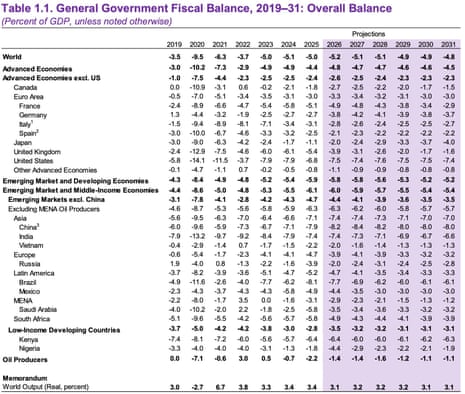
A day after slashing the UK's growth forecasts, the IMF cited Britain as an example of an major economy which managed to trim its borrowings, after the UK's deficit fell from 6.1% of GDP in 2024 to 5.4% in 2025.
In its latest Fiscal Monitor report, just released at its spring meeting in Washington, the IMF says:
double quotation mark In 2025, the headline deficit for advanced economies excluding the United States held broadly steady at 2.4% of GDP. The debt-to-GDP ratio for these economies fell only marginally to 95.3%, effectively unchanged from its 2019 level prior to the COVID-19 pandemic.The United Kingdom recorded a notable improvement, reducing its deficit to 5.4% of GDP, with the change driven by tax increases, tax threshold freezes, and the expiration of temporary measures for energy support.
Canada and Japan also posted gains, reflecting spending restraint. These gains were partly offset by the use of some fiscal space by countries with historically strong fiscal positions, such as Korea and The Netherlands.
The IMF is forecasting that the UK's annual budget deficit will drop to 3.9% of GDP this year, and continue falling until 2031 when it will be 1.6% of GDP, the second-lowest in the G7 after Canada.
In contrast, the US will need revenue and expenditure measures over the medium term to control its deficit, given “the persistence of primary spending and the scale of projected deficitsâ€, the IMF says.
The Fund also warns Rachel Reeves not to stray from her fiscal rules, saying:
double quotation mark In the United Kingdom, adhering to established spending envelopes while strengthening the efficiency of value-added and property taxes is key to rebuilding buffers.
Key events
Please turn on JavaScript to use this feature
Closing post
Time to wrap up….
The head of the International Monetary Fund has encouraged countries to consider ways to conserve energy, warning that the impact of the Iran war will linger even once the conflict ends.
Kristalina Georgieva told reporters in Washington DC that countries should consider measures to cut energy demand, such as free public transport or encouraging working from home.
Georgieva warned countries against taking untargeted actions such as broad energy subsidies to offset the impact of higher prices, saying they would only “prolong the pain of high prices.â€
She warned that there are shortages of oil and gas, naptha, helium and other products in Asia, and expressed concerns about the risk of higher food price inflation unless fertilizer delivery at reasonable prices resume soon.
Georgieva also advised central banks to resist the urge to hike interest rates in response to the Middle East crisis, while also suggesting that those with low credibility may need to act faster.
She was speaking at the IMF's spring meeting, where the Fund also warned that global debt levels continue to rise, and could be pushed highed by the Iran war.
In its half-yearly fiscal monitor, the IMF said global debt levels were on track to increase because the war was pushing up the price of energy and food, fuelling higher government borrowing costs, and hitting economic growth.
After a rise in gross government debt levels to almost 94% of GDP last year, it warned this figure was on track to reach 100% by 2029, a level previously reached only in the aftermath of the second world war.
But the IMF did applaud the UK's efforts to bring down its budget deficit.
That might cheer chancellor Rachel Reeves, who has also been busy in Washington DC today.
Reeves has stepped up her criticism of Donald Trump's war on Iran, describing it as a “mistake†that has destabilised the global economy and damaged living standards around the world.
Reeves calls Trump's Iran war a ‘mistake'

Richard Partington
Rachel Reeves has stepped up her criticism of Donald Trump's war on Iran, describing it as a “mistake†that has destabilised the global economy and damaged living standards around the world, my colleague Richard Partington reports from Washington DC.
In a marked fraying of the transatlantic relationship, the UK chancellor said Trump breaking off from diplomatic talks with Iran and launching airstrikes had not made the world a safer place.
“I think it was a mistake to end those [talks with Iran] and to enter into conflict, because I'm not convinced that we are safer today than we were a few weeks ago,†she told an event in Washington.
The comments on the president's home turf reinforce comments Reeves made just before flying out on Tuesday, when she expressed frustration at the “folly†of his decision to go to war without a clear exit plan.
Speaking as she prepared to meet finance ministers from around the world, Reeves said the war and particularly the halting of Gulf shipping was damaging the living standards of families and businesses in the UK and the US.
More here:
New push to bring water security to 1bn people
Elsewhere at the spring meeting today, the World Bank Group has just launched a new initiative to bring water security to over 1 billion people by 2030.
The “Water Forward†program will “expand reliable water services and strengthen systems against droughts and floods.â€
The Bank said its own funds and technical advice would help improve water supplies to about 400 million people by 2030, with the balance coming from partners.
Speaking at the launch event in Washington DC, WaterAid UK chief executive Tim Wainwright said:
double quotation mark “Water underpins heath, education, gender equality, economies and jobs. But progress has been too slow. What has been missing, is political will and finance. Water Forward brings exactly those two ingredients for change.Water is the foundation of everything – none of us can live without it .â€
UK gas prices below pre-war levels again
The Financial Times has spotted that UK gas prices have dropped back to pre-war levels.
They report:
double quotation mark UK prices, which hit a three-year high of 180p per therm (€71 per megawatt hour) on March 19, have since reversed course to fall to 104p per therm, below prices in January, which peaked at 113p a therm.European prices have also retreated, with the benchmark dropping to €41.35 per MWh (105p per therm), down from a high of €74 per MWh in mid-March.
London's stock market has closed lower tonight, as investors continue to weigh up the prospects of an end to the Iran war soon.
The FTSE 100 share index has dropped by 49.5 points to 10,559 points.
IMF’s Georgieva: UK’s fiscal response is a good example to other
Kristaline Georgieva goes on to pay tribute to the UK government's approach to the current economic challenges.
Georgieva tells Bloomberg TV the UK has a “very mature†approach to policy, and is very careful not to launch indiscriminate spending.
The Bank of England is very clear about the approach they're going to take, the right approach to this situation, she says.
Georgieva adds that:
double quotation mark We see the UK's fiscal response as a good example for other countries.
She contrasts it with other countries who are looking to spend money they don't have.
Support measures have to be targeted, temporary, and within a country's fiscal bounds, she explains.
IMF MD Kristalina Georgieva is speaking to Bloomberg TV now.
Q: is the stock market exuberance misplaced?
Georgieva says that the markets are being driven by “very positive†developments in the world's largest economy, pointing to the high productivity growth in the US.
She suggests investors ought to be less exuberent, though, saying:
double quotation mark But should there be more caution? I would argue yes.
Georgieva points out that we are already seeing quite significant disruption to supply chains – every day the war continues is another day where tankers are not leaving the Gulf.
The International Monetary Fund is not currently discussing an augmentation of Egypt's two-year-old, $8bn IMF loan program despite a severe impact from the Middle East war on the country's economy, IMF managing director Kristalina Georgieva says.
Georgieva told her news conference that the IMF could look at doing more to aid Egypt if conditions worsen further. She also commended the country's authorities for a strong track record on reforms and policies.
Global financial stability seems to be holding for now, Georgieva says (which is slightly comforting…)
IMF calls for countries to economise on energy supplies, and expects more lending programmes
The head of the IMF has predicted that at least a dozen countries, including some in Sub-Saharan Africa, will seek new lending programmes due to surging energy prices and supply chain disruptions caused by the war in the Middle East.
International Monetary Fund managing director Kristalina Georgieva has repeated her estimate that the war could trigger demand for $20bn to $40bn in lending that could include augmentation of existing programs and new programs.
Georgieva began her press conference in Washington DC (see the top of this blog to watch it) by telling reporters that her hopes and prayers are for the Middle East ceasefire to lead to a durable peace.
Georgieva also warned countries against taking untargeted actions such as broad energy subsidies to offset the impact of higher prices, saying they would only “prolong the pain of high prices.â€
She warned that there are shortages of oil and gas, naptha, helium and other products in Asia, and expressed concerns about the risk of higher food price inflation unless fertilizer delivery at reasonable prices resume soon.
As flagged earlier (here), the IMF is also encouraging countries to economize energy use, through measures such as free public transport.
Georgieva argues that the energy shock will incentivize measures to reduce demand.